Contents
 Claude
  ChatGPT
  Perplexity
  Google AI
 Contents
Charter Pro added done-for-you highlight videos to its app, used by fishing guides across the United States. An AI assistant shortlisted the platform, an AI agent wrote the integration, and Shotstack renders every video with no human in the loop.
At a glance
| Industry | Outdoor recreation and fishing charters |
| Use case | Automated highlight videos for fishing trip guests |
| Products used | Edit API |
| Output | Short highlight videos built from guest photos and clips |
| Integration | Fully automated, JSON-driven, built with an AI coding agent |
With Shotstack, Charter Pro:
- Ships a polished highlight video to guests after their fishing trip, with no human touching a single step
- Runs on an integration an AI agent wrote in a couple of days, from evaluation to working code
- Renders each video from up to 30 photos and a minute of raw footage, trimmed to the best moments by AI
- Runs the entire pipeline through one API call, without anyone opening a video editor
- Does all of it without ever contacting support
The challenge: turn a guide’s phone pictures into a keepsake, hands-free
Charter Pro builds software for fishing guides. Guides are experts on the water, not video editors. Their guests go home with a phone full of photos and a story worth sharing, and Charter Pro’s idea was to send every guest a finished highlight video of their trip.
Charter Pro runs lean. Its owner also leads another technology startup, so anything that required manual video work, or even much of his attention, was off the table. Early experiments ran on a browser-based editor driven programmatically, but it solved a different problem. The videos had to come from an API that his backend, or his AI agent, could drive end to end.
An AI assistant built the shortlist
“When I did the research for a new video platform, I actually had AI do it. It brought me five options, and it identified that Shotstack was able to solve our needs.”
Owner, Charter Pro
The shortlist came from the assistant. The decision stayed human: a quick table of pros and cons, pricing, and speed across the five options, with one filter above all, whether a platform did a whole lot more than the job needed. Shotstack fit the job without the excess.
One visit to the website, ever
His first visit to the Shotstack website was also his last. He pasted a small JSON edit into the test console to check two things: how fast the render came back, and whether the JSON was human-readable. Both passed. Everything since has happened through the API.
The solution: an AI-built pipeline with nobody in the loop
Four steps, zero humans
The integration was written by an AI coding agent and working within a couple of days. The pipeline now runs itself:
- After a trip, the guide uploads up to 30 photos and up to a minute of video in the Charter Pro app.
- AI vision scans the raw footage and picks out the few seconds worth keeping, so a 30-second clip becomes its best 8 seconds.
- The backend assembles the edit as JSON, adds licensed background music, and sends it to the Shotstack video editing API.
- The finished highlight video is delivered to the guest on their own recap page.
One request per video
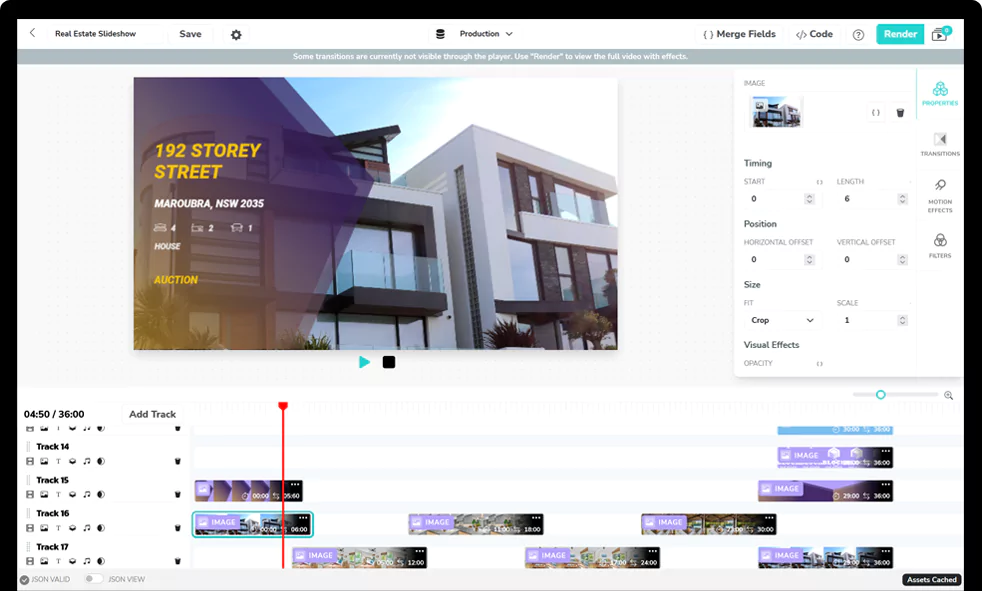
Under the hood, every render is a single request to the Edit API. There is no saved template and no editor session. For each trip, the backend assembles a fresh edit: the AI-picked segment of the raw footage, the guide’s photos in sequence, and licensed music underneath. It describes all of that in one JSON document: which clips, in what order, with what timing and transitions. Then it sends the edit. Shotstack answers with a render ID, the backend checks in until the status comes back done, and the finished video lands on the guest’s recap page.
The ingredients change with every trip. The structure never does. That is the whole integration.
“AI did everything essentially. It was solved pretty quickly, and since then, we have just been using the product. These videos are made automatically for our users. I do not even really see them anymore.”
The results
- A finished video for every trip, zero ongoing work: guests get a shareable keepsake, guides get a marketing asset, and nobody at Charter Pro thinks about rendering.
- A video feature with no video team: no editor, no video hire, and no dashboard habit. The owner has not been back to the website since his first test render.
- Reliability that disappears into the background: renders complete quickly and dependably enough that the whole feature runs unattended.
- Room to grow: the next idea is letting guides choose the style of their videos. Same pipeline, more looks, still no manual work.
“Everything is super quick. Everything works, I would say, flawlessly.”
Why Charter Pro chose Shotstack
The evaluation criteria were fit and legibility, not feature count. A platform that did far more than the job would have counted against it. Shotstack matched the need exactly: a JSON-driven API a backend can call, readable enough that both the human and the AI agent writing the code could reason about it, at a price that made sense.
Turn your users’ photos into video automatically
If your app collects photos and clips, you can build what Charter Pro built. Define the edit as JSON once, let your code (or your AI agent) fill it with each user’s content, and render through the API.
Get a free Shotstack API key and render your first video in minutes.
Get started with Shotstack's video editing API in two steps:
- Sign up for free to get your API key.
- Send an API request to create your video:
curl --request POST 'https://api.shotstack.io/v1/render' \
--header 'x-api-key: YOUR_API_KEY' \
--data-raw '{
  "timeline": {
    "tracks": [
      {
        "clips": [
          {
            "asset": {
              "type": "video",
              "src": "https://shotstack-assets.s3.amazonaws.com/footage/beach-overhead.mp4"
            },
            "start": 0,
            "length": "auto"
          }
        ]
      }
    ]
  },
  "output": {
    "format": "mp4",
    "size": {
      "width": 1280,
      "height": 720
    }
  }
}'

Published August 25, 2026
Derk Zomer is the founder and CEO of Shotstack. He writes about video automation, AI-generated media and building on the Shotstack API. More from Derk
Experience Shotstack for yourself.
- Seamless integration
- Dependable high-volume scaling
- Blazing fast rendering
- Save thousands